Inertia is the central principle behind flywheel technology. It may
also be the central reason why chemical battery-based UPSes have been
the predominant backup approach for SME data centers over the last
three decades. But market inertia and convention are no reason to
overlook the potential benefits that flywheel UPS systems could offer
your organization now.
Flywheels At A Glance
A
flywheel is a mechanical device that stores rotational energy. In
modern data centers, flywheels that are spun at a constant rate by a
small motor can store enough energy to power large computer systems for
short spans of time, just as chemical battery backups do. If the power
to the flywheel’s motor cuts out, a flywheel-based, online UPS uses the
flywheel’s stored kinetic energy as the basis for generating
electricity. The UPS itself is a generator. This generation sucks
energy out of the system, but there’s enough energy there to result in
a few minutes of runtime in a properly sized system.
|
Key Points
•
Flywheels store kinetic energy that can convert instantly into
electrical energy when employed in an online UPS product with much
greater reliability than battery-based UPS systems.
• The
environmental benefits of flywheel technology vs. battery are legion,
from superior power efficiency to the elimination of toxic chemical
containment and disposal.
• Despite the higher up-front costs
of flywheel systems, there are many ways in which the technology can
more than pay for itself in a fairly short time.
|
A
traditional generator, like the ones waiting around to kick in and
power your data center after a sustained loss of power, converts fuel
into mechanical energy, which is then converted into electrical energy.
A battery-based UPS takes electrical energy from the wall and stores it
in chemicals, from which it can be extracted and used again as
electricity. The flywheel-based UPS also takes electricity from the
wall, stores it as kinetic energy, then converts that kinetic energy
into mechanical energy and from that into electrical energy.
The Battery Fallacy
The
trouble for flywheels has always been that battery-based UPSes
generally deliver 10 to 15 minutes of runtime. According to Gary
Rackow, vice president of sales for the Americas at Active Power (www.activepower.com),
this battery runtime is his company’s chief competition. Rackow notes
that years ago, it was common for mainframes to run single
applications. He used to watch IBM practice drills in which an
application went through an orderly shutdown in less than 10 minutes,
and so a 10-minute UPS was perfect. Today, though, with data centers
running multiple applications across multiple systems, such numbers are
impractical. The race is not to shut down the applications; it’s to
power up the generators. If the generator doesn’t start, Rackow
asserts, people who think one can be repaired in less than 10 or 15
minutes are deluding themselves.
“Properly designed engine
systems are typically running and under load in eight seconds,” he
says. “The national electric code for all health care facilities
requires that their standby engines must be started in under 10
seconds. Everybody’s had an engine that can do that for years. If
they’re properly maintained, it’s not an issue. You don’t need 15
minutes. You really don’t even need 15 seconds. But for some people,
it’s a giant leap of faith to go there.”
|
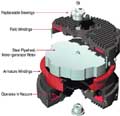
Flywheel UPSes are mechanical devices that store rotational energy.
|
“Most
modern generators will ignite in five minutes or less,” adds Forrester
analyst James Staten, who says that most implementations of new
flywheels give you more than five minutes. “There’s much more of a
connection between the two at this point,” he continues. “You see those
kind of generators a lot in tier 4 data centers, which have mission
criticality and never go down.”
Viewed from a thermal angle, the battery proposition is even more erroneous. As Pentadyne (www.pentadyne.com)
literature illustrates, today’s servers and rack densities have rigid
environmental cooling demands. If the power fails, “you have less than
60 seconds to have the genset online and powering the cooling systems;
otherwise thermal server crash is inevitable.”
Flywheel Rationale
There
are three reasons to consider a flywheel-based UPS solution: space,
long-term cost, and environmental concerns. Space is the simplest.
Active Power’s Rackow draws the picture of a flywheel-based UPS
occupying a 4-foot square closet while an equivalent battery-based UPS
occupies the same depth but is 20 feet long. Magnified across the
expanse of a data center and its many systems, that’s a lot of dead
real estate devoted to batteries that might otherwise be earning
revenue.
Long-term costs and environmental concerns can be
closely tied, as in the relationship between local resources and the
cost of electricity, or polar opposites. As Forrester’s Staten notes,
“In a down economy, ‘green’ goes from being environmental to being
about money. We’re just not seeing people doing anything for purely
environmental benefits. It’s all about economic benefits.”
Flywheel-based
systems carry higher initial price tags than their battery-based
counterparts, but Active Power’s Rackow states that flywheel solutions
can recoup their higher costs in 18 to 24 months. This ROI hinges on
several less-discussed liabilities with battery technology. Battery
lifetimes are generally rated with a 100% figure dependent on the
battery never being used. Every instance of battery usage lessens its
potential maximum utility, and load sags and cuts occur regularly to
businesses. Some record hundreds of such drops per year. Moreover,
batteries must be maintained at under 75 degrees Fahrenheit for optimal
performance, a much costlier proposition when battery-based UPSes are 6
to 8% less power efficient than flywheel-based UPSes, according to
Active Power.
Pentadyne pegs UPS battery MTBF at around
10,000 hours. Its flywheel devices are rated at 875,000 hours.
Containment requirements for battery systems exist because batteries
can swell and split, releasing toxic chemicals and gases. Battery
states in general are difficult to gauge and time-intensive to
maintain, and many data centers don't maintain batteries as well as
they should. Poor battery maintenance can lead to literally explosive
results. In comparison, flywheel technology entails nearly no
maintenance time or expense.
Going green can pay dividends in
other ways. Active Power’s Rackow notes one user who installed about 2
megawatts of flywheel UPS product. The customer then went to the local
power company, explained that they opted for the more power-efficient
flywheel solution over conventional battery, and the utility cut the
company a rebate check for $125,000. Rackow says that many power
companies offer such programs, as it defers the expenses they would
incur in building out more infrastructure, but few data center managers
know of or claim these rebates.
“There’s a lot of concern now
about energy efficiency and the greenness of your company,” says
Forrester’s Staten. “Having lead acid or even lithium ion batteries
exposes you to hazardous waste disposal expenses. If you’re in Europe,
where carbon credits are a concern and hazardous waste can be a rather
expensive thing to deal with, this is far more appealing. But now that
there’s a lot of U.S. companies that care about energy efficiency, even
without the carbon credits, this is a more appealing technology than
it’s been in the past.”
Staten points out that “a flywheel
solution is also magnitudes better toward getting LEED certification
than battery backup.” The LEED (Leadership in Energy and Environmental
Design) Green Building Rating System (www.usgbc.org/leed)
outlines a lengthy set of standards for eco-friendly construction.
LEED-compliant buildings may be more expensive to build, but many
states offer significant tax incentives for adherence; plus, there are
less tangible public perception benefits tied to being LEED-certified.
True
enough, larger data centers will recoup the added expense of buying a
flywheel-based UPS solution more quickly than an SME. But the more a
data center planner cares about environmental concerns and is willing
to take a longer-term view on ROI, the more flywheel technology will
become a persuasive proposition, especially for new data center builds.

Article by William Van Winkle for .