Accordance Uses RAID To Lessen A Data Center's Vulnerability To Data Loss
 As companies of all sizes become increasingly aware of just how much their data is worth, they're getting smarter about backing it up and ensuring their operations aren't compromised in case of hard drive failure.
Accordance Systems (http://www.accordancesystems.com/), which makes and sells the ARAID line of RAID solutions, has adapted its products to meet the needs of enterprises that may previously have shied away from this technology due to concerns about cost and complexity.
"The typical user in a small- to medium-sized business tends to run off of a PC that contains only one drive," says Steve Johnson, president and CEO of Accordance USA. "Our devices run two drives concurrently as one drive, keeping redundant copies of data that is being read and written to at all times."
 Reducing Vulnerability To Zero
Redundancy is especially important to SMEs because they are particularly vulnerable in the event of catastrophic data loss. If a single-drive PC or server suffers a disk failure, any work done between the time of the last successful backup and the point of failure-a period that can range anywhere from a few hours to a week, depending on backup scheduling-is lost. Because data is constantly being written to two drives, a RAID-based solution reduces this window of vulnerability to zero.
To keep costs down, SMEs have often relied on tape-based backup systems. Johnson says Accordance's solutions render tape obsolete.
"Our devices basically plug in to any computer and set up a RAID array, just like that," says Johnson. "The markets are finally understanding that drives are cheap enough that this becomes your backup strategy and discipline instead of tape."
A two-drive RAID array allows one of the two hot-swappable drives to be removed for offsite storage, which supports cycling of recent backups offsite without the window of vulnerability of non-RAID solutions.
RAID For The Rest Of Us
While RAID technology has been around in various forms for more than 30 years, its use has mostly been limited to larger shops with the resources to implement and maintain these relatively complex solutions within a data center environment. RAID as a straightforward desktop solution for SMEs has been mostly a nonstarter. Accordance is changing that thinking.
Johnson says packaging makes all the difference-and makes it easier for companies that might have otherwise implemented single-drive, nonredundant desktop and server storage to instead go the RAID route.
"Although RAID is already supported by a lot of motherboards, the average solution still forces you to deal with software," says Johnson. "You have to install it and configure it, and then you have overhead with respect to performance. You also have to figure out where you're going to put a second drive."
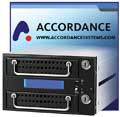
Solutions from Accordance do away with these multiple elements of overhead that can keep average shops from adopting RAID. Its solutions house two drives, primary and secondary, and are easily inserted into a standard 5.25-inch storage bay.
"But what really separates us is our software," adds Johnson. "We're really a software company. All of our software is already embedded in the device, so as far as your system is concerned, our products look just like a regular SATA hard drive."
The result is simplified implementation for organizations of all sizes and IT capabilities. Johnson is proud that his company provides a solution for anyone, running on any platform-including virtually any flavor of Windows, Mac OS, Linux, or Unix-without the traditional implementation or management overhead associated with conventional RAID products.
Deep Engineering Roots
That capability has deep roots on both sides of the planet. Accordance Systems was founded in Taipei, Taiwan, in 1998. Six years later, the company's search for an SNMP-compliant agent for its ARAID line of devices brought its leaders to a group of embedded systems programmers at Icon Laboratories in Des Moines, Iowa. Johnson says his team had more than 25 years of experience in building embedded real-time operating systems and firmware. The Taiwanese firm was interested in an industry-leading RAID-compliant SNMP agent that the Icon Labs team had created. Accordance Systems liked the agent, which allows simplified monitoring of drive operation and performance over a network, so much that they formed a joint venture, Accordance USA, in 2004 to spearhead its North American expansion.
The firm has continued to evolve the ARAID product line, and in addition to internal units, it also sells external devices with integrated power supplies and network connections, as well as OEM solutions for PC vendors. Its RAID 0 and RAID 1 products, which support USB, FireWire, and SATA, can be deployed across a broad range of client and network architectures.
"You just drop it on the network and off you go," says Johnson, "which is an important point to make given how expensive it can be to recover from a drive failure."
Johnson says you'd be mistaken to assume that RAID and real-time redundant backup technologies apply only to spinning disk drives. Although SSDs (solid-state drives) are still too expensive on a per-gigabyte basis to supplant conventional drives, inevitable improvements in manufacturing will drive SSDs closer to the storage mainstream. Johnson says no matter which storage media prevails on the desktop or in the data center, Accordance Systems will have solutions in place to preserve data integrity.
"Every form of storage has its own failure rates," he says. "Even if you have SSD storage, what do you do when that SSD storage fails? How is that backed up? You're always going to have storage, and that storage will always be susceptible to failure."
Whatever those solutions look like, Johnson is confident his team is ready to deliver.
"We have the expertise and the skill set. We're a data protection company, a redundancy company, and a software company. We understand this discipline better than anyone out there." 
Carmi Levy for  .